Introduction to AWS Cloud Concepts
Welcome to your first lesson on AWS Cloud Concepts! In this lesson, we'll explore the fundamental ideas that make cloud computing powerful and understand why AWS has become the leading cloud platform. Even if you've never worked with cloud services before, this lesson will give you a solid foundation.
Learning Goals:
- Understand what cloud computing is and its key characteristics
- Learn the essential AWS Cloud Concepts and service models
- Recognize the benefits of cloud computing over traditional IT
- Get familiar with AWS's shared responsibility model
What is Cloud Computing?
Cloud computing is the on-demand delivery of IT resources over the internet with pay-as-you-go pricing. Instead of buying, owning, and maintaining physical data centers and servers, you can access technology services like computing power, storage, and databases on an as-needed basis.
Think of it like this: instead of generating your own electricity at home (traditional IT), you pay an electric company for the power you use (cloud computing).
Key Characteristics of Cloud Computing
- On-Demand Self-Service: You can provision computing capabilities automatically without requiring human interaction with AWS staff.
- Broad Network Access: Services are available over the network and accessed through standard mechanisms.
- Resource Pooling: AWS serves multiple customers using a multi-tenant model, with different physical and virtual resources dynamically assigned.
- Rapid Elasticity: Capabilities can be elastically provisioned and released to scale rapidly outward and inward.
- Measured Service: Cloud systems automatically control and optimize resource use by leveraging a metering capability.
AWS Cloud Service Models
AWS offers three main service models, each providing different levels of control and management:
-
Infrastructure as a Service (IaaS): You get access to networking features, computers (virtual or dedicated hardware), and data storage space. Example: Amazon EC2 (virtual servers)
-
Platform as a Service (PaaS): You deploy your applications without managing the underlying infrastructure. Example: AWS Elastic Beanstalk
-
Software as a Service (SaaS): You use a complete product that runs and is managed by the service provider. Example: Amazon Chime (video conferencing service)
Think of the service models like transportation:
- IaaS: Renting a car (you drive, but don't own the vehicle)
- PaaS: Taking a taxi (you specify destination, driver handles the driving)
- SaaS: Riding a bus (fixed route and schedule, you just get on)
Benefits of AWS Cloud Computing
- Cost Savings: Eliminate capital expenses and pay only for what you use.
- Scalability: Scale resources up or down based on demand.
- Reliability: Multiple geographic regions and availability zones provide business continuity.
- Security: AWS provides robust physical and network security.
- Performance: Latest generation computing and storage technologies.
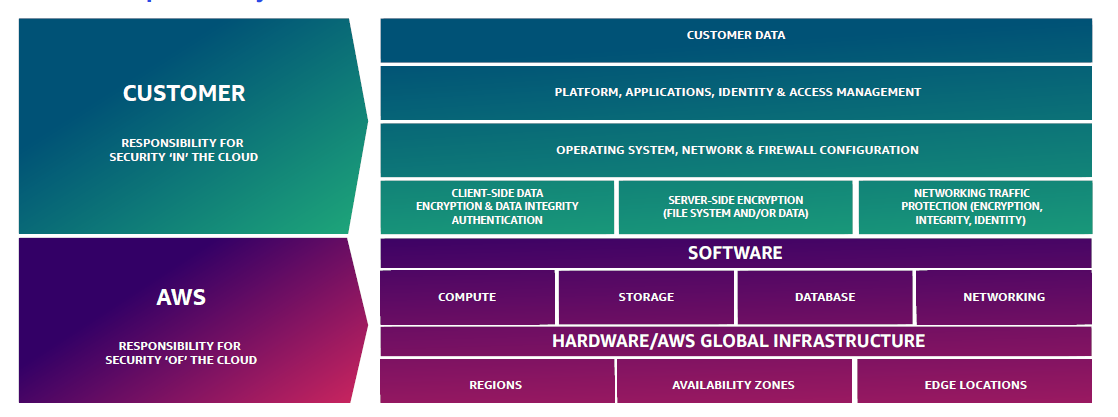
AWS Shared Responsibility Model
This is a critical concept in AWS security. AWS is responsible for security of the cloud, while you're responsible for security in the cloud.
Common Pitfalls
- Assuming AWS handles all security: Remember the shared responsibility model - you're still responsible for securing your applications and data
- Over-provisioning resources: Start small and scale as needed to avoid unnecessary costs
- Ignoring cost monitoring: Set up billing alerts early to avoid surprises
- Not planning for multiple regions: Consider geographic distribution for better performance and reliability
- Poor access management: Don't use root accounts for daily tasks; create IAM users with appropriate permissions
Summary
In this lesson, we've covered the fundamentals of AWS cloud computing. You now understand what cloud computing is, the key characteristics that define it, the different service models (IaaS, PaaS, SaaS), the significant benefits over traditional IT, and the crucial shared responsibility model for security. These concepts form the foundation for all AWS services you'll learn about in upcoming lessons.
Quiz
AWS Cloud Concepts – Quick Check
Which cloud characteristic allows you to automatically scale resources based on demand?