AWS Certified Cloud Practitioner (CLF-C02) Summary
The AWS Certified Cloud Practitioner (CLF-C02) exam validates foundational knowledge of the AWS Cloud — independent of any technical role. It is ideal for individuals starting their cloud journey, especially from non-IT backgrounds.
Exam Overview
Purpose of the Exam
Demonstrates understanding of:
- AWS Cloud value proposition
- Shared responsibility model
- Security best practices
- AWS billing, pricing, and economics
- Core services (Compute, Storage, Network, Database)
Target Audience
- Beginners with 0–6 months of AWS exposure.
- Individuals from non-technical or business backgrounds.
- Roles such as sales, finance, management, or support.
Out of scope tasks
- Coding
- Architecture design
- Troubleshooting
- Performance testing.
Exam Domains & Weightage
| Domain | Description | Weight |
|---|---|---|
| Cloud Concepts | AWS benefits, Well-Architected Framework, migration strategies, and cloud economics | 24% |
| Security and Compliance | Shared responsibility model, IAM, encryption, and compliance tools | 30% |
| Cloud Technology and Services | Core AWS services: compute, network, storage, database, AI/ML, analytics, and global infrastructure | 34% |
| Billing, Pricing, and Support | Pricing models, cost tools, budgets, and AWS support plans | 12% |
Domain 1: Cloud Concepts
- Benefits of the AWS Cloud: scalability, elasticity, cost savings.
- AWS Well-Architected Framework pillars: operational excellence, security, reliability, performance efficiency, cost optimization, sustainability.
- Migration & Cloud Adoption Framework (CAF)
- Cloud economics: CAPEX vs OPEX, automation, rightsizing.
Domain 2: Security and Compliance
- Shared Responsibility Model: AWS secures the cloud; you secure your workloads.
- Access Management: IAM users, roles, MFA, IAM Identity Center (SSO).
- Security Services: GuardDuty, Inspector, Security Hub, Shield, WAF.
- Compliance Tools: AWS Artifact, CloudTrail, Config, Audit Manager.
Domain 3: Cloud Technology and Services
- Compute: EC2, Lambda, Fargate, ECS, EKS, Auto Scaling, Load Balancing.
- Storage: S3, EBS, EFS, FSx, Glacier, Storage Gateway, Backup.
- Database: RDS, Aurora, DynamoDB, Neptune, DMS.
- Networking: VPC, Route 53, CloudFront, Direct Connect, Global Accelerator.
- AI/ML & Analytics: SageMaker, Comprehend, Lex, Kendra, Athena, QuickSight, Glue, Kinesis.
- Other Key Categories: Application Integration (SNS, SQS, EventBridge), Management Tools (CloudWatch, CloudFormation), and IoT (IoT Core, Greengrass).
Domain 4: Billing, Pricing, and Support
Pricing Models
- Compute: On-Demand, Reserved, Spot, Savings Plans, Dedicated.
- Data Transfer: Charges vary by direction and region.
- Storage: Tier-based pricing for S3 and EBS.
Cost Tools
- AWS Pricing Calculator
- AWS Budgets
- Cost Explorer
- Billing Conductor
Support Plans
- Basic, Developer, Business, Enterprise On-Ramp, Enterprise.
- Access resources like AWS Support Center, Trusted Advisor, and Health Dashboard.
Key Takeaways
- Focus on understanding concepts, not implementation.
- Learn Well-Architected pillars, pricing models, and core services.
- Study IAM, CloudFormation, EC2 families, and S3 tiers.
- Review security, cost management, and support tiers.
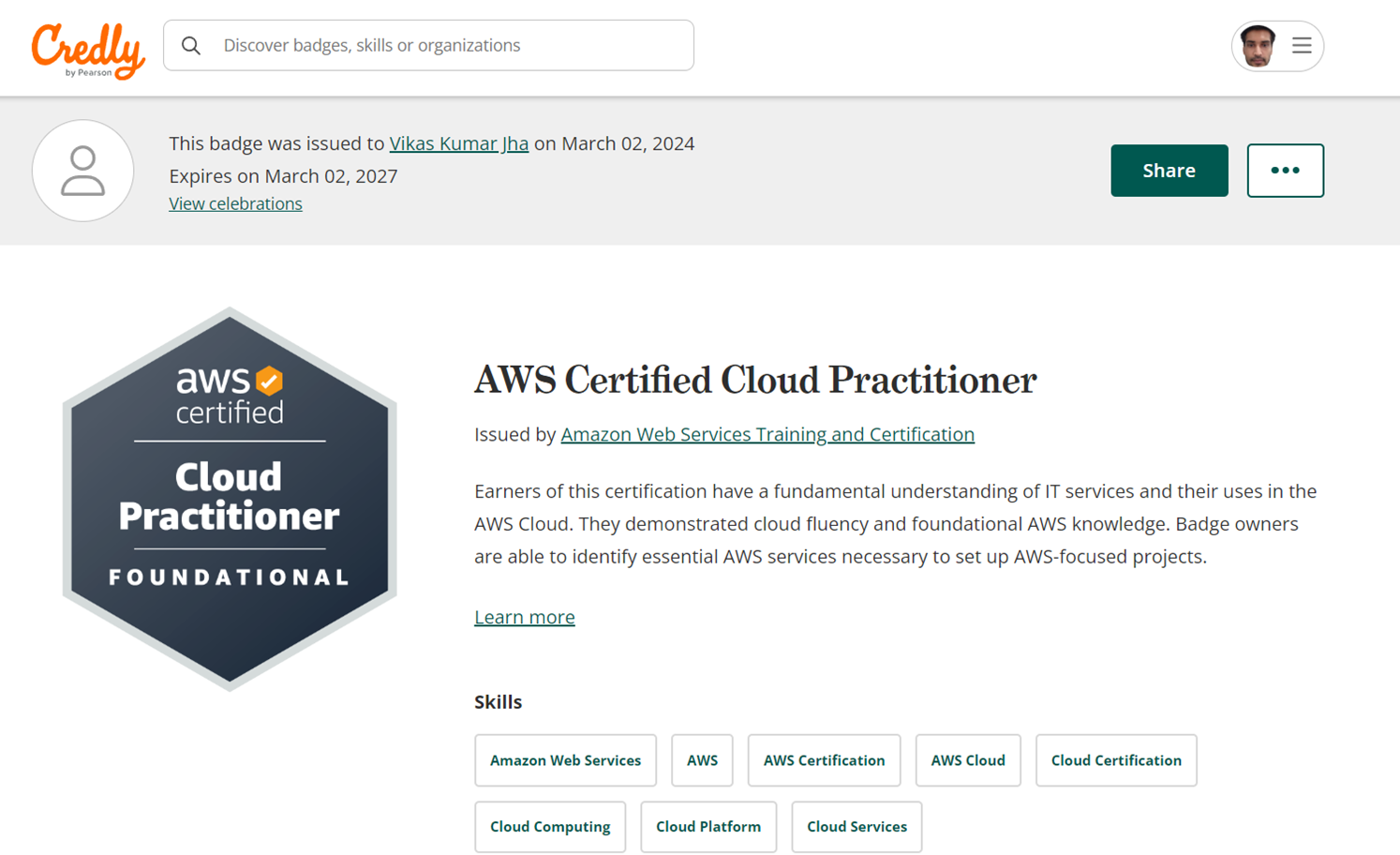
AWS Certification from Credly
Recommended Study Resources
- AWS Certified Cloud Practitioner Official Page
- AWS Skill Builder Courses
- AWS Whitepapers & FAQs
- AWS Well-Architected Framework
Syllabus
- 01. Introduction to AWS Cloud Concepts
- 02. AWS Global Infrastructure Overview
- 03. Core AWS Services: Compute and Storage
- 04. AWS Database Services Fundamentals
- 05. AWS Networking and Content Delivery
- 06. Security and Identity Access Management (IAM)
- 07. Monitoring with CloudWatch and CloudTrail
- 08. AWS Pricing Models and Cost Management
- 09. AWS Well-Architected Framework
- 10. High Availability and Fault Tolerance
- 11. Application Integration Services
- 12. Deployment and Management Tools
- 13. Security Services Beyond IAM
- 14. Data Encryption and Key Management
- 15. Disaster Recovery Strategies
- 16. Auto Scaling and Load Balancing
- 17. Serverless Computing with AWS Lambda
- 18. Migration and Hybrid Cloud Architecture
- 19. AWS Support Plans and Trusted Advisor
- 20. Exam Preparation and Practice Tests